
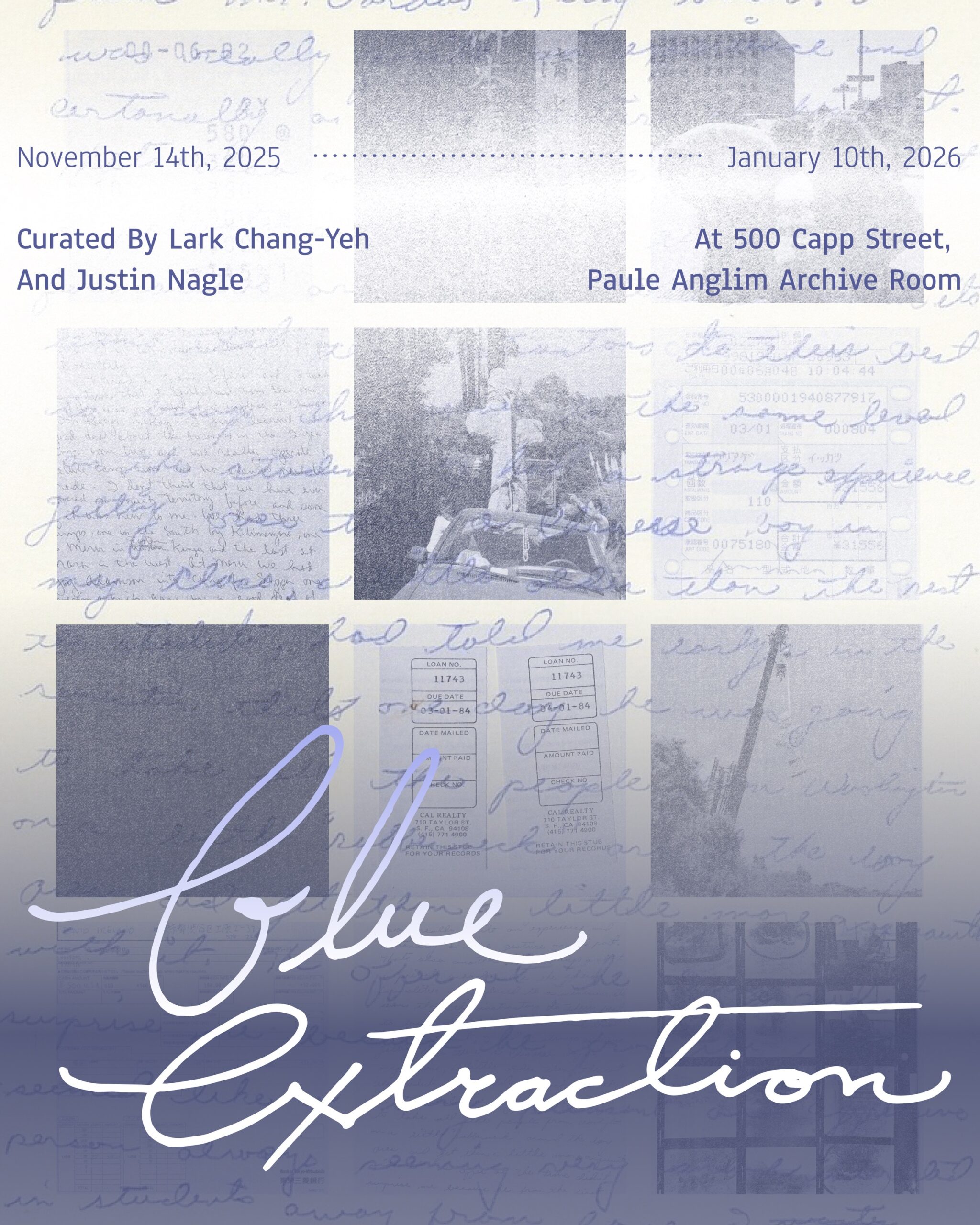
In conversation with Catherine Wagner’s Blue Reverie in the main house, Blue Extraction returns to the color blue–considering the color’s origin. Blue is a color only made possible through the advent of mining because it wasn’t a pigment naturally found in soil. David’s pieces featured in Blue Reverie are formally concerned with blue and mediate on blue as a cultural reference, such as in his Yves Klein (International Klein Blue) fix-all blobs. Blue Extraction instead captures Ireland’s intimate, mundane, and often incidental use of blue through handwritten letters, travel receipts, photographs, and ticket stubs.
The show both extracts blue ephemera and objects from David’s archive, and also looks towards the use of the color blue in these pieces as a way to trace and uncover David’s history with colonial extraction. Through analyzing the objects and ephemera Ireland held onto, we recall his lesser-known personal history of running an African safari and an import business called “Hunter Africa” which sold game skins and furs amongst other interior design objects. Ireland ran the “Hunter Africa” store before his artistic career took off, ultimately shaping his future practice and the lens in which he viewed other cultures and extractivism.
Among his ephemera are film photography contact sheets taken during his Eastern Africa safaris. The blue mark-making using grease pencil on these sheets represent a practical decision of selection, as boxing and circling images indicate which photos will be printed. This blue act of selection mirrors “hunting” itself, and also the act of extraction, as he encircles wildlife. Paired with his Hunter Africa ephemera are Ireland’s wax sculptures resembling Oryx, skulls, antelope, buffalo horns, and antlers. His depiction of these animal parts as white objects resembling bone separates them from the animal through abstraction.
Following the thread of blue throughout his ephemera, the show wraps around the archive room, bringing his trips to Japan into focus. Ireland saved receipts, ticket stubs, exchange memos—practical and mundane records that serve as proof of his travels. These cultural encounters shaped his material experiments of encasing porcelain objects in concrete. Ireland is interested in porcelain as a material, extracting it from its cultural context, and obscuring it into his own textural and sculptural language. These artworks relate to Ireland’s import business, and how his displacement of objects across cultures and geographies translates to his artistic practice.
Historically, archives often build their collections through colonial extraction, framing their archive, and thus how we understand and remember history through a lens that often others and exoticizes. Blue Extraction interrogates Ireland’s archive, considering the lens of whiteness in his preservation of objects and ephemera from other cultures, and ultimately how it shaped his art.
This exhibition features work from the David Ireland Collection and is curated by Lark Chang-Yeh with curatorial assistance and collaboration from Justin Nagle