Blog

The Andy Warhol Foundation Honors 500 Capp Street through “The Philanthropy Factory”

We are happy to announce that 500 Capp Street has been selected to participate in the inaugural “Philanthropy Factory,” a new initiative honoring Andy Warhol’s philanthropic legacy by providing recent grantees an opportunity to benefit from the sale of Warhol works from the Andy Warhol Foundation’s collection.

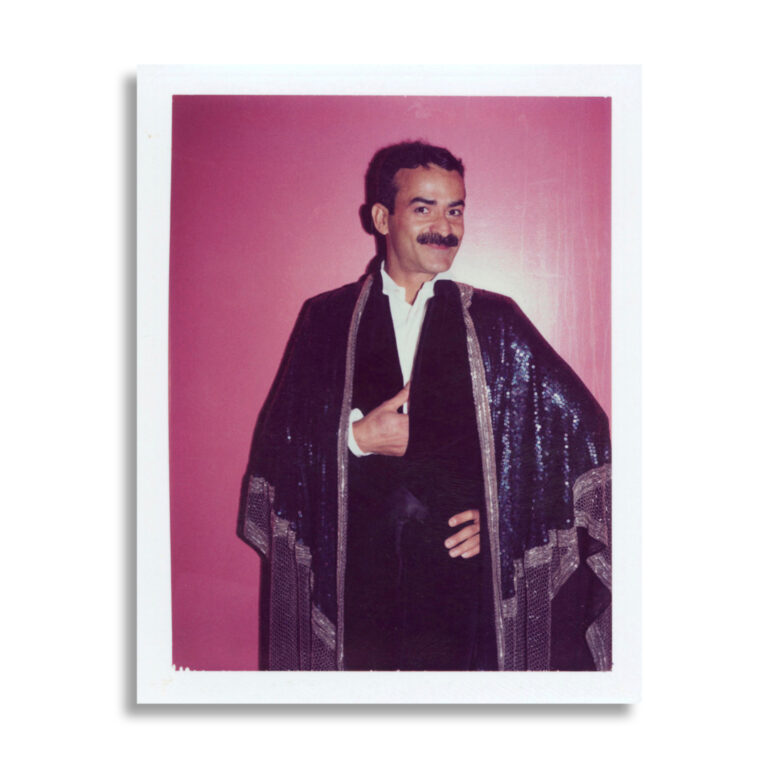
Highlighted above is a Polaroid taken by Andy Warhol of Halston’s partner and Warhol’s assistant, Victor Hugo. Hugo, a performance artist and window designer, was a constant figure in Warhol’s photographs. Usually depicted by Warhol in a sexualized and provocative context, often fully nude or with his penis out, here he is seen in a different facet, as a member of the Studio 54 royal court.

Our fall programming is proudly supported by the Andy Warhol Foundation, and we are honored to be selected for this fundraising opportunity. All proceeds from the sale of seven Warhol pieces will go towards supporting 500 Capp Street’s operations, enabling us to continue encouraging artistic experimentation through our programming and artist residencies.

This work and more are available here. Don’t miss this chance to support 500 Capp Street and grab yourself an exclusive Andy Warhol piece.

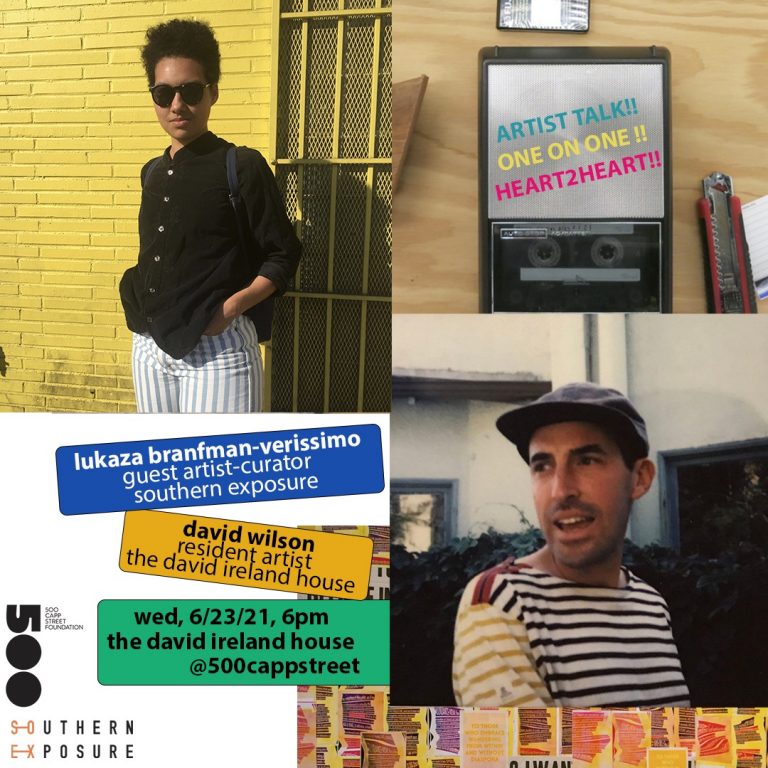
Artist conversation between Lukaza Branfman-Verissimo & David Wilson

Wednesday, June 23, 6 pm PT
In Person & Online

Join us for an intimate artist conversation between David Wilson and Lukaza Branfman-Verissimo on Wednesday, June 23 at 6pm. Drop by in person, or tune in on Instagram Live @500cappstreet. David Wilson is the resident artist of The David Ireland House while artist Lukaza Branfman-Verissimo is the curator of Southern Exposure’s current exhibition, We use our hands to support. They have previously collaborated with one another and now find themselves in the same neighborhood doing collective exhibition work. Join the artists as they check in on each other, share stories and, exchange experiences of their work processes in an intimate one-on-one dialog.

This program will take place outdoors on The David Ireland House terrace. Free and open to the public.

Doors: 5:30 pm PT
Program: 6:00 pm PT

Links to the shows:
We use our hands to support, Curated by Lukaza Branfman-Verissimo at Southern Exposure @southernexposuresf

Sittings, David Wilson exhibition after 4 months of residency at The David Ireland House @500cappstreet

About the artists:

Lukaza Branfman-Verissimo is an artist, activist, educator, storyteller & curator who lives/works between Ohlone Land [Oakland, CA] and Powhatan Land [Richmond,VA]. Their work has been included in exhibitions and performances at Konsthall C [Stockholm, Sweden], SEPTEMBER Gallery [Hudson, NY], EFA Project Space [New York City, NY], Leslie Lohman Museum [New York City, NY], San Francisco State University Gallery, Signal Center for Contemporary Art [Malmo, Sweden], Yerba Buena Center for the Arts [San Francisco, CA] and Berkeley Art Museum and Pacific Film Archive [Berkeley, CA], amongst others. For the past 5 years, Lukaza has been the Lead Curator at Nook Gallery [Oakland, CA], collaborating with over 80+ artists, writers, performers & musicians, in a gallery located in their apartment kitchen. They are currently enrolled in an MFA program at Virginia Commonwealth University in Richmond, VA.


David Wilson creates observational drawings based on direct experiences with landscape and orchestrates site-based gatherings that draw together a wide net of artists, performers, filmmakers, chefs, and artisans into collaborative relationships. He organized the experimental exhibition The Possible at the Berkeley Art Museum and Pacific Film Archive (BAMPFA) and received the San Francisco Museum of Modern Art (SFMOMA) 2012 SECA Art Award. He has exhibited his work with SFMOMA, was included in the 2010 CA Biennial, and presented a Matrix solo exhibition at BAMPFA. Wilson has received grants from The Andy Warhol Foundation, Southern Exposure, The Center for Craft and the Kenneth Rainin Foundation. He is based in Oakland, CA.


It’s a Lamp! Opening Reception

Celebrate SF Art Week with us at 500 Capp Street as we open It’s a Lamp!, our concept store’s new show with San Francisco artist and electrician Rico Duenas. Featuring never-before-seen works, the exhibition continues Duenas’ ongoing dialogue with the late artist David Ireland, nearly five years after his celebrated project Light Repair. In this new body of work, Duenas expands his poetic relationship to illumination—treating lamps not merely as functional objects, but as sculptural vessels in active dialogue with the architecture and icons of the David Ireland House.

Date: January 20, 2026
Time: 4-8 pm
Price: Free
Register Here

Trina Michelle Robinson: Open Your Eyes to Water

500 Capp Street and Root Division present Open Your Eyes to Water, a solo exhibition of the work of San Francisco-based visual artist Trina Michelle Robinson that spans both venues.

For nearly a decade, Robinson has utilized an embodied, research-based, and multidisciplinary approach rooted in personal and historical archives to create immersive installations that engage ancestry, memory, and the layered geographies of Black migration. Robinson’s interdisciplinary practice moves fluidly across film, printmaking, sound, and installation. 

At 500 Capp Street, Robinson will create a living installation tracing her years-long cross-continental engagement with family lineage and movement from Senegal, to Kentucky, Chicago, and California. At Root Division, the artist will present an expanded version of Elegy for Nancy (2022)—a tender tribute to her oldest known ancestor, a woman named Nancy who was born in 1770s Kentucky, then still part of Virginia. The installation will feature special altar contributions from Bay Area Black women artists, highlighting how collective knowledge, imagination, and care can reframe historical erasure.

About the Artist

Trina Michelle Robinson is a San Francisco-based visual artist. Her work has been exhibited at the BlackStar Film Festival in Philadelphia, the San Francisco Art Commission Main Gallery, ICA San José, Minnesota Street Project, New York’s Wassaic Project, Bay Area Now 9 at Yerba Buena Center for the Arts and For-Site’s Black Gold: Stories Untold. Her work is also included in Paper is People: Decolonizing Global Paper Cultures, a traveling exhibition co-curated by Tia Blassingame and Stephanie Sauer, which was at San Francisco Center for the Book in 2024 and in Atlanta in 2025. She had a solo exhibition at the Museum of the African Diaspora (MoAD), a Smithsonian Affiliate. Robinson is a 2024 SFMOMA SECA Award finalist and  was recently nominated for the 2024 Anonymous Was A Woman (AWAW) Award. Her print series Ghost Prints of Loss is included in the book Is Now the Time for Joyous Rage?, published in 2023 by CCA Wattis Institute for Contemporary Arts and Sternberg Press. She received her M.F.A. from California College of the Arts in 2022.

It’s a Lamp!

 San Francisco–based artist and electrician Rico Duenas is back at 500 Capp Street with It’s a Lamp, a solo exhibition presented in the foundation’s concept store, The Accordion Shop. Featuring never-before-seen works, the exhibition continues Duenas’ ongoing dialogue with the late artist David Ireland, nearly five years after his celebrated project Light Repair. In this new body of work, Duenas expands his poetic relationship to illumination—treating lamps not merely as functional objects, but as sculptural vessels in active dialogue with the architecture and icons of the David Ireland House. Working with humble and often discarded materials, Duenas transforms the familiar into something quietly radiant. Through these objects, Duenas frames light as a tactile, living material that softly shapes our interactions with the environment around us.

Duena’s exhibition can be viewed January 20 till February 3 in the Accordion Shop at 500 Capp Street, Fridays and Saturdays from 12-5 pm.

Rico Duenas was born and raised in San Francisco. As a child, he spent time on the east coast with his grandfather, a sculptor and founding member of Skowhegan School of Painting and Sculpture. In San Francisco, he also often accompanied his father to flea markets and garage sales, where his father bought, fixed, and re-sold furniture. It was there that he was introduced to artist Kevin Randolph, who was repurposing lights, and quickly developed a love of lighting and sculpture. He lives and works in San Francisco as a union electrician and artist.

Memory Pieces

Experiencing Catherine Wagner’s Blue Reverie project at 500 Capp is a memory trigger. Not only because David Ireland’s house is a place that is so full of history and memories burnished into the surface of the shimmering walls. Inside there are the cracks of use and the patina of age within a transparent seal, these surfaces now serve as a backdrop, a stage for new activity.

For me, the memory trigger is of my past work with artists. People connect, orbit, and intersect over time. This is a narrative looped in place, in San Francisco art history, and it spans centuries. That sounds so epic in scope, but in fact, it is the truth—going from the 20th to the 21st centuries over the course of 25 years. Art history has a way of layering—500 Capp Street was built in the 19th century so there is a third one. Here we are, in 2025 considering two artists in convergence, in an aesthetic conversation.

In 1998, I worked with David Ireland and Catherine Wagner as part of a group exhibition, titled Museum Pieces: Bay Area Artists Consider the DeYoung at that museum in Golden Gate Park. Ireland and Wagner are two very different artists and personalities, yet both of their work grapples with history, makes visual sense, or in the case of Ireland, a bit of productive nonsense, of what came before. Both are also deeply connected to the Bay Area, as I have been. I feel a connection with this reconnection.

The DeYoung project came out of a wonderful and unexpected invitation. It was a validating moment when Steve Nash, who was then the Associate Director and Chief Curator at the Fine Arts Museums of San Francisco, offered me the opportunity to organize an exhibition at the deYoung. (How times have changed—this was an invitation, not something I had to lobby hard for—he knew of my writing and curatorial projects in small SF galleries. Hard yes!) At that time, the museum, itself with roots in the 19th century, was housed in a stately but architecturally undignified building made homelier due to its seismic vulnerability. It was propped up with very visible steel beams at its front door, more like a walker with neon green tennis balls on its legs than a deconstructive architectural flourish. But the museum also was dowdy programmatically and its keepers knew it needed a refresh.

The charge was to find a way to connect a group of contemporary artists who lived and worked in the Bay Area to the DeYoung, to make itself more relevant. In conversation with Nash and then FAMSF Director Harry Parker, we settled on the premise of inviting artists to make new works responding to the crumbling museum.

The deYoung was anticipating its future in a more glamorous 21st century building designed by Herzog and deMeuron. (It is worth noting that back then, the building design was highly controversial, viewed by many vocal locals as a modernist abomination .) I was truly honored to have been asked to do a project like this, one that grew out of my presence as an art writer—Nash was aware of my reviews and essays in the Bay Guardian-- and smaller curatorial projects that I'd done here and there. This would be my first exhibition that I organized for a museum.

I asked artists who were part of my community or had admired from a close proximity in writing about their work— Rebeca Bollinger, Chris Johanson, Deborah Oropallo, Maria Porges, Rigo 99 (23), Harrell Fletcher and Jon Rubin. who were at the time a team, as were Sergio de la Torre and Julio Morales. But it was also an opportunity to connect with artists who seemed legendary for their contributions-- Tom Marioni, for his Bay Area Conceptual chops, and Doug Hall, a media arts pioneer and SFAI faculty.

Nash and I discussed Ireland and Wagner for their interest in architecture and history: Ireland also had role in Bay Area conceptualism but also had a strong relationship to historic buildings— transforming the military buildings in the Marin Headlands into the art center, and of course 500 Capp Street, the house/artwork that is his greatest work.

Wagner’s iconic photographs of the Moscone Center under construction, and her visual interrogations of homes and classrooms in separate bodies of work, also seemed like a perfect fit for the show. This project was my first meeting with Wagner—who has been a colleague and friend ever since. From the start she was a dynamic force, full of ideas and enthusiasm. She immediately had an plan for how to engage with the museum—to look at its infrastructural elements and photograph them formally. She wasted no time setting up a studio on site to photograph display hardware as well as ledger books of the museum's initial collection. The latter, a fascinating history lesson in themselves, included an extremely eclectic range of materials, art and artifacts that seemed more like a flea market kunstkammer than a 21st century museum. The ledger books had lovely, marbled endpapers and notations in florid script, probably made with fountain pens. These served as her photographic subjects. We had great conversations, and it was thrilling to see the work emerge from out of the dusty warrens of the museum basement.

Working in situ, I have learned, is her forte.

It is particularly satisfying to work with artists on new projects because there is a sustained dialogue, relationships that build. I lived in the Mission at the time, and would pick Ireland up at his house to go to the museum for meetings and for installation. I’m not sure if he was carless or if he was an environmentalist who preferred carpooling, but the shared commute provided an opportunity to get to know him better. Those interactions provided the first times I had entered the magical place where he still lived. Before that time, seeing him around town at art openings and events, I was intimidated by his looming presence. He had a deceptively earnest demeanor, the San Francisco artist as tall and wise white-haired as John Baldessari was in LA, both had that clichéd, godlike vibe. Being able to enter Ireland’s world humanized him, to a point. To me, he was something like another David—Lynch, an all-American eccentric. Ireland told me about his daily habits, about how each morning he would sweep the sidewalk outside his home, a former accordion-maker's shop, and how amidst the leaves and soot would be used syringes and condoms from the neighborhood's night street life. The act was wholesome, but the setting was hardly that. He was a scrappy, mischievous artist.

David also had a clear idea for a project at the de Young: to cut open one of the gallery walls and expose the infrastructure. I loved the gesture and was amazed that the museum went for it. He wanted to go even further, to poke all the way to the exterior, literally letting in fresh air. Therein was his prankster spirit, pushing things to the limit. The de Young team was wonderful to work with, and I think we benefited from the disrepair of the building-- to remove a sheetrock wall wasn't such a big deal in a structure that wasn't much longer for this world. (It felt like this was the last show, but the museum wasn't demolished until 2002 . This was another form of humanization, like performing surgery on an institution.

We didn’t know what we would find inside the cavity of that wall. Would there be dead animals—or even a body, as was later discovered at the Henry Kaiser Pavilion in Oakland when they were doing renovation work there? What was inside was a very different kind of surprise: The exposed wall was brick seemingly slathered with black tar, with white streaks of lime, with traditional red brick above—through this project we all learned that the building was a mishmash of additions and subtractions. Ireland laid that bare, as did Maria Porges in an irreverent audio tour. But the real surprise was the pale brown concrete pillar with two letters in red spray paint. I,D,I. From one angle it read ID—Freudian or identification-- and from the other, DI, the artist’s initials. Ireland fumed at the coincidence. It was too perfect, almost cutesy in its cosmic whimsy. He had a real, unwitting connection to the building. He called the piece Disclosure.

I suppose there is also a coincidence to the repeated connection between Wagner and Ireland in 500 Capp. In Museum Pieces, the two artists were in the same gallery, along with three portraits—of chief curator, director, and guest curator (me)—white men-- painted by Caitlin Mitchell Dayton. Looking back at the images, I still think there was a pretty good dialogue in that room.

Writing this was an opportunity to dig into my archives. I found Wagner’s wall label, which featured a quote. She wrote of her pictures:
“These photographs record objects that are used for the protection and transportation of art objects. By recontextualizing these support systems as artworks themselves, I have initiated a chain reaction among the element of support and the object, thereby questioning the nature of the creative gesture.”

A quarter-century later, that latter term resonates with Wagner’s recent installation. Enigmatic objects abound in 500 Capp, a house which itself is a support system. Ireland’s ultramarine blobs, Wagner’s wooden fragments and the large photographs of blue light bulbs– these touchstones that encapsulate ideas and inspirations for another chain reaction yet to come.

2025/26 International Residency Open Call Jurors

Thank you to all of the wonderful artists who applied to our 2025/26 International Artist Residency Open Call! We were truly inspired by the range, depth, and care in the proposals we received, and we’re grateful for the time and trust you put into sharing your work with us. For this cycle, our residency’s artist will be selected by an inspiring jury of artists artists and curators. We are honored to announce Jo-ey Tang, Julio César Morales, Amy Berk, and MJ Brown

Jo-ey Tang has served as curator at Palais de Tokyo, Paris; Director of KADIST San Francisco; Director of Exhibitions of Beeler Gallery at Columbus College of Art & Design; and arts editor of n+1. He has curated exhibitions at Centre Pompidou, Paris; Pinacoteca de São Paulo; K11 Art Foundation, Hong Kong and chi K11 Art Museum, Shanghai; Blaffer Art Museum, University of Houston; and with his ongoing project arms ache avid aeon: Nancy Brooks Brody / Joy Episalla / Zoe Leonard / Carrie Yamaoka: fierce pussy amplified, at Institute of Contemporary Art, Philadelphia; Palais de Tokyo, Paris; and Participant Inc, New York.
Photo by Gina Osterloh

Julio César Morales is an accomplished artist, educator, and curator. In curatorial practice, Morales has a range of experience: executive director and lead curator at Museum of Contemporary Art. Tucson (2022-2025), senior curator at Arizona State University Museum (2012-2022), adjunct curator for visual arts at Yerba Buena Center for The Arts in San Francisco (2008-2012), and founder and director of Queens Nails Annex, an artist-run project space in San Francisco (2003-2012). In 2013 he was a contributing curator for the Japanese pavilion at the Venice Biennal. 
Photo by Renee Zellweger

Amy Berk is the head of education at 500 Capp street. She taught at San Francisco Art Institute from 2006-2022, serving as Chair for the Contemporary Practice program from 2011 to 2013. As an artist, she has shown her work nationally and internationally. Berk received an MFA from SFAI and a BA in Studio Art and English from Wesleyan University. 
Photo by Geloy Conception

MJ Brown is currently the Director of Development of Headland center for the Arts in Sausalito, CA and sits on the Board of Directors at Contemporary Art Review Los Angeles (Carla). MJ has previously worked in creative communities including Ballroom Marfa, The Redford Center, Christie’s San Francisco, Kemper Art Museum (Washington University in St. Louis), and White Flag Projects.

Blue Reverie Catalogue Launch Party

Join us for the launch of Blue Reverie: Catherine Wagner, the catalogue celebrating Wagner’s current exhibition at 500 Capp Street. On December 16th from 5–7pm, secure yourself a copy of this limited-run publication by our friends at Colpa Press, with remarks by Catherine Wagner and a special reading by Glen Helfand.

Date: December 16, 2025

Time: 5 – 7pm

Price: Free

Tickets